
Forklift Trucks - Maintenance
On this page
What safety procedures should you follow when servicing a forklift truck?
Back to top- Allow only qualified persons to service and maintain equipment.
- Follow the manufacturer's service and maintenance schedule.
- Wear proper personal protective equipment. Wear goggles when grinding. Wear face shields (with safety goggles), aprons, gloves and rubber boots when handling lead-acid batteries or working around battery-charging equipment. Wear leather gloves when changing liquefied petroleum gas (LPG) fuel tanks.
- Disconnect all batteries before doing any work or prevent motion by raising the drive wheels off the floor or using chocks or other truck-positioning devices.
- Before servicing liquefied petroleum gas (LPG) forklifts:
- Shut off the tank fuel valve.
- Run the engine until it stops.
- Disconnect the tank from the hose.
- Block the forklift securely when removing wheels.
- Support the forklift hood in an upright position or remove it to do work.
- Keep the work area clean and well-lit.
- Clean spilled oil or hydraulic fluid immediately.
- Check all tools before using.
- Remove all tools and parts before starting the engine.
- Handle batteries with care.
- Avoid contact with battery terminals with hoisting chains, tools and metal objects.
- Cover the battery top with insulating material.
- Attach a chain hoist to the counterweight before removing it from a forklift.
- Find out why a forklift is in for repairs before starting or driving it.
- Check the operator's daily checklist before making repairs.
What should you not do when servicing a forklift truck?
Back to top- Do not leave parts, creepers, cans, tools, or other obstacles around.
- Do not lift beyond your capacity. Use hoist or leverage tools to lift or move heavy parts or equipment.
- Do not smoke, weld, or light a match around refuelling and battery-charging areas.
- Do not start a forklift if it is on a lift hoist or wheel stands.
- Do not work on forklift attachments unless you are familiar with their operation.
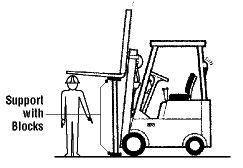
- Do not work beneath elevated forklift trucks or forks unless they are securely supported by approved blocks.
- Do not run LPG, gas or diesel forklifts in unventilated areas.
How often should maintenance inspections be conducted, and what should be examined on a forklift truck?
Back to topThree types of service report inspections are recommended by CSA's B335-15 (R2020) "Safety standard for lift trucks". All inspections should be done by a trained, qualified maintenance technician.
- A planned maintenance inspection which should be done according to the manufacturer's recommended interval. If there are no recommendations, conduct the inspection approximately every 200 hours.
- An annual planned maintenance inspection which should occur approximately every 2000 hours, or annually, whichever comes first.
- A lifting capacity inspection which is carried out to determine whether the lift truck is capable of handling the maximum load specified on the nameplate. This inspection shall be done before the lift truck being used for the first time, each time the lift truck is acquired by a new owner, and as often as recommended by the manufacturer, but no less than once per year.
Other tips include:
- Check the bolts holding the counterweight to the body and replace any worn or missing bolts.
- Inspect by magnetic particle testing the main mast welds and forks annually or when cracks appear.
- Inspect by magnetic particle testing all hoses, couplings, fittings, and connections to the cylinders in the main mast assembly and the tilt control system.
- Inspect forks for distorted, twisted, or bent sections. If defects are found, test the area of concern.
- Determine if the forklift can handle the maximum recommended load limit.
- Fact sheet last revised: 2024-12-19