
Tractors - Roll-over Prevention
On this page
How do you prevent backward upsets?
Back to topIn a backward tip, the tractor can hit the ground in less than one and a half seconds.
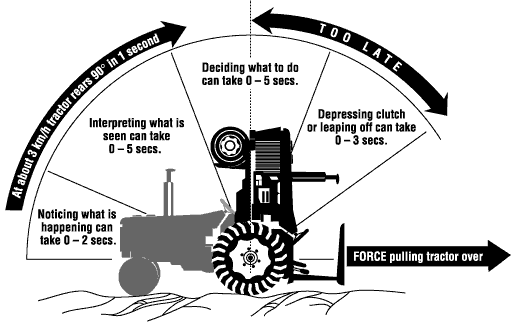
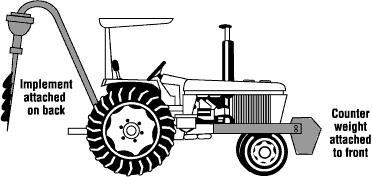
Factors that cause a tractor to tip over backward depend upon the load and the height of the hitch from the ground.
Use a tractor equipped with a rollover protective structure (ROPS), and a seat belt. If not available, have the tractor retrofitted.
- Hitch only at the manufacturer's recommended height.
- Engage the clutch pedal slowly and smoothly. Be ready to disengage power quickly if the front end begins to come up.
- Start forward motion slowly and change speed gradually.
- Use counterweights to increase tractor stability. Follow the manufacturer's instructions.
- Avoid moving backwards downhill.
- Drive around ditches, not across them.
- Back your tractor out when stuck or tow the stuck machine out with another tractor. Tractors are also prone to tipping when the wheels are stuck - for example, in mud or snow, or in contact with boards, logs, chains, etc. used in an attempt to improve traction, but which actually prevent the wheels from turning.
- Turn downhill when working across a slope.
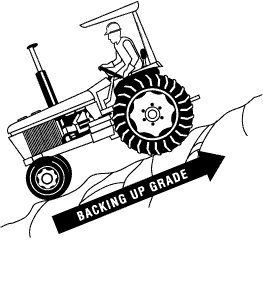
- Drive straight down even the gentlest slope. Do not drive diagonally across it. Back up hills.
- Do not hitch a load higher than the tractor drawbar.
- Do not coast downhill (that is, do not go downhill with the clutch engaged). Before starting down a hill, shift to a lower gear that prevents freewheeling and excessive braking. Try to use the same gear to go down a hill that you would use to pull the load uphill.
- Add front-end weights when raising heavy rear-mounted equipment.
- Keep front-end loader buckets low when pulling rear-mounted loads.
How do you prevent sideways upsets?
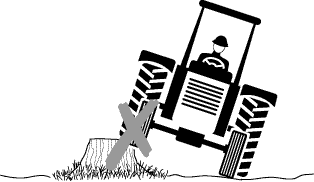
Back to topAbout 85 percent of all tractor rollovers are side rollovers. Side rollovers depend upon the centre of gravity and centrifugal force of the tractor. The centre of gravity is the location where all of the tractor’s weight is equally balanced, both front to back and side to side. This point can change due to attachments and weight from a load, such as when the material is carried in a front-end loader. The centre of gravity must remain within the tractor’s base of stability for the tractor to remain in an upright position. Confirm with the manufacturer where the base of stability is for each tractor. Centrifugal force is the force that pushes out on a tractor as the tractor makes a turn.
Some causes of side rollovers include:
- Driving too fast when turning on a curve.
- Driving too close to an incline, embankment, or a ditch.
- Driving the tractor with a loaded front-end loader in the raised position.
- Losing control of the tractors due to excessive load on the drawbar.
- Applying uneven braking while travelling at high speeds.
To prevent side rollovers, operators should:
- Set wheels as wide as practical for maximum stability. Check with the manufacturer’s recommendations before making changes.
- Use features such as wide tires, the ability to lock brakes together, and a fixed drawbar height.
- Drive at an appropriate speed.
- Avoid depressions and obstacles.
- Turn downhill, not uphill, if stability becomes uncertain on slopes or ramps.
- Keep loads, implements, or loader buckets close to the ground during transport or when turning.
- Keep side-mounted implements on the uphill side.
- Match speed to conditions and loads.
- Slow down when pulling rear-mounted equipment.
- Drive forward down steep slopes and back up them.
- Lock brake pedals together before high-speed travel.
- Slow down before turning.
- Use the engine for braking when going downhill.
- Stay away from the edge of ditches, embankments, steep slopes, and streams.
- Do not try to cross steep slopes.
- Fact sheet last revised: 2024-10-31