Silica, quartz
On this page
- What are other names or identifying information for silica?
- What is the WHMIS classification?
- What are the most important things to know about silica in an emergency?
- What are the potential health effects of silica?
- What are first aid measures for silica?
- What are fire hazards and extinguishing media for silica?
- What are the stability and reactivity hazards of silica?
- What are unintentional release measures for silica?
- What handling and storage practices should be used when working with silica?
- What is the American Conference of Governmental Industrial Hygienists (ACGIH®) recommended exposure limit for silica?
- What are the engineering controls for silica?
- What Personal Protective Equipment (PPE) is needed when working with silica?
What are other names or identifying information for silica?
Back to topCAS Registry No.: 14808-60-7
Other Names: Crystalline silica, Quartz; Silicone dioxide; Tripoli
Main Uses: Many uses including in mining, fabrication, manufacturing, and construction
Appearance: Colourless crystals.
Odour: Odourless
Canadian TDG: Not specifically listed in Canadian TDG Regulations, but may be regulated as part of a chemical family or group Not Otherwise Specified (N.O.S.). Consult the regulations.
What is the WHMIS classification?
Back to topAccording to the Commission des normes, de l'équité, de la santé et de la sécurité du travail (CNESST), silica (quartz) can be classified as:
Carcinogenicity - Category 1A
Specific target organ toxicity - repeated exposure - Category 1
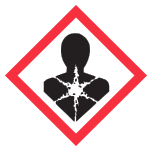
The signal word is danger.
The hazard statements include:
- May cause cancer.
- Causes damage to organs through prolonged or repeated exposure
Please note that this classification was retrieved from the CNESST site on March 3, 2025 and was established by CNESST personnel to the best of their knowledge based on data obtained from scientific literature and it incorporates the criteria contained in the Hazardous Products Regulations (SOR/2015-17). It does not replace the supplier’s classification which can be found on its Safety Data Sheet.
What are the most important things to know about silica in an emergency?
Back to topEmergency Overview: Colourless crystals. Odourless. Will not burn. VERY TOXIC. Prolonged or repeated exposure causes damage to the lungs. CANCER HAZARD. May cause cancer, if inhaled.
What are the potential health effects of silica?
Back to topMain Routes of Exposure: Inhalation; skin contact; eye contact.
- Inhalation: At high concentrations: can irritate the nose and throat.
- Skin Contact: Not irritating.
- Eye Contact: May cause slight irritation as a "foreign object". Tearing, blinking and mild temporary pain may occur as particles are rinsed from the eye by tears.
- Ingestion: Not harmful.
- Effects of Long-Term (Chronic) Exposure: VERY TOXIC. Can cause lung damage if the dust is breathed in. Symptoms may include shortness of breath, chronic cough and weight loss. There may be a decrease in lung function and the ability to do some physical activities. In severe cases, there can be effects on the heart and death from heart failure.
- Carcinogenicity: CARCINOGEN. Known to cause: lung cancer.
- International Agency for Research on Cancer (IARC): Group 1 - Carcinogenic to humans.
- American Conference for Governmental Industrial Hygienists (ACGIH): A2 - Suspected human carcinogen.
- Teratogenicity / Embryotoxicity: Not known to harm the unborn child.
- Reproductive Toxicity: Not known to be a reproductive hazard.
- Mutagenicity: Conclusions cannot be drawn from the limited studies available.
What are first aid measures for silica?
Back to topInhalation: Take precautions to ensure your own safety before attempting rescue (e.g., wear appropriate protective equipment). Move the victim to fresh air.
Skin Contact: Quickly and gently blot or brush away the excess chemical. Wash gently and thoroughly with gently flowing water and non-abrasive soap for 5 minutes.
Eye Contact: Quickly and gently blot or brush the chemical off the face. Immediately flush the contaminated eye(s) with gently flowing water for 5 minutes, occasionally lifting the upper and lower eyelids. If irritation or pain persists, get medical attention.
Ingestion: Have the victim rinse their mouth with water. Get medical attention if the victim feels unwell.
First Aid Comments: If exposed or concerned, see a medical professional for advice. All first aid procedures should be periodically reviewed by a medical professional familiar with the chemical and its conditions of use in the workplace.
Note to Physicians: Some jurisdictions specifically regulate an ingredient of this product and require a complete medical surveillance program. Specific information should be sought from the appropriate government agency in your jurisdiction.
What are fire hazards and extinguishing media for silica?
Back to topFlammable Properties: Does not burn.
Suitable Extinguishing Media: Not combustible. Use an extinguishing agent suitable for surrounding fire.
Specific Hazards Arising from the Chemical: None known. Not known to generate any hazardous decomposition products in a fire.
What are the stability and reactivity hazards of silica?
Back to top- Chemical Stability: Normally stable.
- Conditions to Avoid: Generation of dust.
- Incompatible Materials: Increased risk of fire and explosion on contact with: oxidizing agents (e.g. peroxides). Not corrosive to metals.
- Hazardous Decomposition Products: None known.
- Possibility of Hazardous Reactions: None known.
What are unintentional release measures for silica?
Back to topPersonal Precautions: Evacuate the area immediately. Isolate the hazard area. Keep out unnecessary and unprotected personnel. Ventilate area.
Methods for Containment and Clean-up: Avoid dry sweeping. If necessary, use a dust suppressant such as water. Do not use compressed air for clean-up. Collect using a shovel/scoop or approved HEPA vacuum and place in a suitable container for disposal.
What handling and storage practices should be used when working with silica?
Back to topHandling: Before handling, it is important that all engineering controls are operating and that protective equipment requirements and personal hygiene measures are being followed. Only trained personnel should work with this product. Immediately report leaks, spills or failures of the safety equipment (e.g. ventilation system). Avoid generating dusts. Prevent unintentional contact with incompatible chemicals.
Storage: Keep the amount in storage to a minimum. Empty containers may contain hazardous residue. Store separately. Keep closed. Store in an area that is: separate from incompatible materials.
What is the American Conference of Governmental Industrial Hygienists (ACGIH®) recommended exposure limit for silica?
Back to topACGIH® TLV® - TWA: 0.025 mg/m3 A2 (respirable)
Exposure Guideline Comments: TLV® = Threshold Limit Value. TWA = Time-Weighted Average. A2 = Suspected human carcinogen.
Adapted from: 2025 TLVs® and BEIs® - Threshold Limit Values for Chemical Substances and Physical Agents and Biological Exposure Indices. Cincinnati: American Conference of Governmental Industrial Hygienists (ACGIH)
NOTE: In many (but not all) Canadian jurisdictions, the exposure limits are similar to the ACGIH® TLVs®. Since legislation varies by jurisdiction, contact your local jurisdiction for exact details. A list is available in the OSH Answers on Canadian Governmental Occupational Health & Safety Departments.
A list of acts and regulations that cover exposure limits to chemical and biological agents is available on our website. Please note that while you can see the list of legislation for free, you will need a subscription to view the actual documentation.
What are the engineering controls for silica?
Back to topEngineering Controls: Use a local exhaust ventilation and enclosure, if necessary, to control the amount in the air. It may be necessary to use stringent control measures such as process enclosure to prevent product release into the workplace.
What Personal Protective Equipment (PPE) is needed when working with silica?
Back to topEye/Face Protection: Safety goggles suitable for dust protection.
Skin Protection: It is good practice to prevent skin contact.
Respiratory Protection:
Up to 0.5 mg/m3: (APF = 25) Any powered, air-purifying respirator with a high-efficiency particulate filter; Any supplied air respirator operated in a continuous-flow mode. Up to 1.25 mg/m3: APF = 50) Any air-purifying, full-facepiece respirator with an N100, R100, or P100 filter; Any powered, air-purifying respirator with a tight-fitting facepiece and a high-efficiency particulate filter.Up to 2.5 mg/m3: (APF = 1000) Any supplied-air respirator operated in a pressure-demand or other positive-pressure mode.APF = Assigned Protection Factor
Recommendations apply only to National Institute for Occupational Safety and Health (NIOSH) approved respirators. Refer to the NIOSH Pocket Guide to Chemical Hazards for more information.
- Fact sheet last revised: 2025-03-10