
Work-related Musculoskeletal Disorders (WMSDs)
On this page
What are work-related musculoskeletal disorders (WMSDs)?
Back to topWork-related musculoskeletal disorders (WMSDs) are a group of painful disorders of muscles, tendons, and nerves. Examples include carpal tunnel syndrome, tendinitis, thoracic outlet syndrome, and tension neck syndrome.
For the purpose of developing injury prevention strategies, many health and safety agencies include only disorders that develop gradually and are caused by the overuse of the above constituents of the musculoskeletal system. The traumatic injuries of the muscles, tendons, and nerves due to accidents are generally not considered to be WMSDs. However, some organizations, such as the European Agency for Safety and Health at Work and the National Institute for Occupational Safety and Health (NIOSH), include acute traumas and fractures within the WMSD group.
This document will discuss injuries resulting from overuse and those that develop over time. Frequent and repetitive work activities or activities with awkward postures cause these disorders, which may be painful during work or at rest.
Almost all work requires the use of the arms and hands. Therefore, most WMSDs affect the hands, wrists, elbows, neck, and shoulders. Work using the legs can lead to WMSD of the legs, hips, ankles, and feet. Some back problems also result from repetitive activities.
Are there other names for WMSDs?
Back to topWMSDs are very difficult to define within traditional disease classifications. These disorders have received many names, such as:
- Repetitive motion injuries.
- Repetitive strain injuries.
- Cumulative trauma disorders.
- Occupational cervicobrachial disorders.
- Overuse syndrome.
- Regional musculoskeletal disorders.
- Soft tissue disorders.
Most of the names do not accurately describe the disorders. For example, the term "repetitive strain injuries" suggests that repetition causes these disorders, but awkward postures also contribute. Sometimes, these terms are used interchangeably. For simplicity, the WMSD term is used in this document.
What are the risk factors for WMSDs?
Back to topWMSDs arise from movements such as bending, straightening, gripping, holding, twisting, clenching, and reaching. These common movements are not particularly harmful in the ordinary activities of daily life. What makes them hazardous in work situations is the continual repetition, often in a forceful manner, the speed of the movements, and the lack of time for recovery. WMSDs are associated with work patterns that include:
- Fixed or constrained body positions.
- Continual repetition of movements.
- Force concentrated on specific parts of the body, such as the hand or wrist.
- A pace of work that does not allow sufficient recovery between movements.
WMSDs commonly occur as a result of a combination and interaction among these factors.
Heat, cold, and vibration also contribute to the development of WMSDs.
To read more about the WMSD risk factors, visit our OSH Answers document Work-related Musculoskeletal Disorders (WMSDs) - Risk Factors.
How do WMSDs occur?
Back to topThis document discusses WMSDs that develop gradually as a result of repeated trauma.
WMSDs typically include three types of injuries:
- Muscle injury.
- Tendon injury.
- Nerve injury.
Muscle Injury
When muscles contract, they use chemical energy from sugars and produce by-products, such as lactic acid, which are removed by the blood. A muscle contraction that lasts a long time reduces the blood flow. Consequently, the substances produced by the muscles are not removed fast enough, and they accumulate in the muscles. The accumulation of these substances irritates muscles and causes pain. The severity of the pain depends on the duration of the muscle contractions and the amount of time between activities for the muscles to get rid of those irritating substances.
Tendon Injury
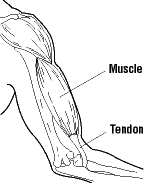
Tendons consist of numerous bundles of fibres that attach muscles to bones. Tendon disorders related to repetitive or frequent work activities and awkward postures occur in two major categories – tendons with sheaths (Fig. 1), found mainly in the hand and wrist; and tendons without sheaths (Fig. 2), generally found around the shoulder, elbow, and forearm.
The tendons of the hand are encased in sheaths through which the tendon slides.
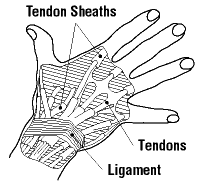
The inner walls of the sheaths contain cells that produce a slippery fluid to lubricate the tendon. With repetitive or excessive movement of the hand, the lubrication system may malfunction. It may not produce enough fluid, or it may produce a fluid with poor lubricating qualities. Failure of the lubricating system creates friction between the tendon and its sheath, causing inflammation and swelling of the tendon area. Repeated episodes of inflammation cause fibrous tissue to form. The fibrous tissue thickens the tendon sheath and hinders tendon movement. Inflammation of the tendon sheath is known as tenosynovitis.
When inflamed, a tendon sheath may swell up with lubricating fluid and cause a bump under the skin. This bump is referred to as a ganglion cyst.
Tendons without sheaths are vulnerable to repetitive motions and awkward postures. In fact, when a tendon is repeatedly tensed, some of its fibres can tear apart. The tendon becomes thickened and bumpy, causing inflammation. Tendonitis is the general term indicating inflammation of the tendon. In some cases, such as in the shoulder, tendons pass through a narrow space between bones. A sac called the bursa, filled with lubricating fluid, is inserted between the tendons and the bones as an anti-friction device. As the tendons become increasingly thickened and bumpy, the bursa is subject to a lot of friction and becomes inflamed. Inflammation of the bursa is known as bursitis.
Nerve Injury
Nerves carry signals from the brain to control the activities of muscles. They also carry information about temperature, pain, and touch from the body to the brain and control bodily functions such as sweating and salivation. Nerves are surrounded by muscles, tendons, and ligaments. With repetitive motions, awkward postures, and other strenuous actions, nerves can be compressed if surrounding tissues become swollen. (Fig. 3A, 3B).
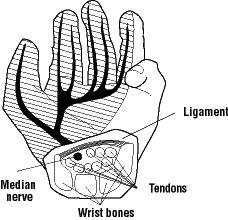
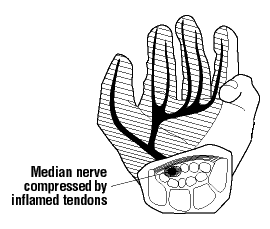
Compression of a nerve causes muscle weakness, sensations of "pins and needles," and numbness. Dryness of skin and poor circulation to the extremities may also occur.
What are the symptoms of WMSDs?
Back to topPain is the most common symptom associated with WMSDs. In some cases, there may be joint stiffness, muscle tightness, redness, and swelling of the affected area. Some workers may also experience sensations of "pins and needles," numbness, skin colour changes, and decreased sweating of the hands.
WMSDs may progress in stages from mild to severe.
Early stage: Aching and tiredness of the affected limb occur during the work shift but disappear at night and during days off work. There is no reduction in work performance.
Intermediate stage: Aching and tiredness occur early in the work shift and persist at night. Reduced capacity for repetitive work.
Late stage: Aching, fatigue, and weakness persist at rest. Inability to sleep and to perform light duties.
Not everyone experiences these stages in the same way. In fact, it may be difficult to say exactly when one stage ends and the next begins. The first pain, numbness, or tingling are signals that the muscles and tendons should rest and recover. Otherwise, an injury can become longstanding, and sometimes irreversible. The earlier people recognize symptoms, the quicker they should respond to them.
The table below outlines occupational risk factors and symptoms of the most common upper body disorders associated with WMSDs.
| Identified disorders, occupational risk factors, and symptoms | ||
|---|---|---|
| Disorders | Occupational risk factors | Symptoms |
| Tendonitis/ tenosynovitis | Repetitive wrist motions Repetitive shoulder motions Sustained hyperextension of arms Prolonged load on shoulders | Pain, weakness, swelling, burning sensation or dull ache over the affected area |
| Epicondylitis (elbow tendonitis) | Repeated or forceful rotation of the forearm and bending of the wrist at the same time | The same symptoms as tendonitis |
| Carpal tunnel syndrome | Repetitive wrist motions Awkward hand positions Strong gripping Mechanical stress on the palm Vibration | Pain, numbness, tingling, burning sensations, wasting of muscles at the base of the thumb, dry palm |
| De Quervain's disease | Repetitive hand twisting and forceful gripping | Pain at the base of thumb |
| Thoracic outlet syndrome | Prolonged shoulder flexion Extending arms above shoulder height Carrying loads on the shoulder | Pain, numbness, swelling of the hands |
| Tension neck syndrome | Prolonged restricted posture | Pain |
| Lower back pain | Lifting heavy loads Awkward posture Whole body vibration | Pain |
How are WMSDs recognized?
Back to topThe evaluation of WMSDs includes identifying workplace risks. Evaluation begins with a discussion about the worker's job activities and requires a detailed description of all the processes involved in a typical workday. Consideration is given to the frequency, intensity, and duration of each task performed at work.
Diagnosis of WMSDs can be confirmed by performing laboratory and electronic tests that determine nerve or muscle damage. One such test, electroneuromyography (ENMG), encompasses two areas: electromyography (EMG) and nerve conduction velocity (NCV). Magnetic resonance imaging (MRI), an alternative to X-rays, provides images of tendons, ligaments, and muscles and improves the quality of the diagnostic information.
How are WMSDs treated?
Back to topThe treatment of WMSDs involves several approaches, including the following:
- Restriction of movement.
- Application of heat or cold.
- Exercise.
- Medication and surgery.
Restriction of Movement
The first approach to the treatment of WMSDs is to avoid the activities causing the injury. This approach often requires work restrictions. In some cases, transfer to a different job should be considered. A splint can also be used to restrict movements or to immobilize the injured joint. However, the use of splints in occupational situations requires extreme caution. If used inappropriately, splints can cause more damage than good. Splints are usually used for two reasons: to mechanically support a joint where an excessive load on the joint is anticipated or to restrict the movement of the injured joint.
In the occupational context, splints should not be used as a mechanical support for the joint. Instead, the job should be redesigned to avoid the extreme load on the worker's joint in the first place. To be effective, the use of splints to immobilize an affected joint also requires that the work activity that caused the injury be stopped or changed. If injurious work continues, the worker is exposed to the risk of injury to other joints that have to compensate for the splinted one.
Application of Heat or Cold
Applying heat or cold seems to relieve pain and may accelerate the repair process.
Cold reduces pain and swelling and is recommended for injuries and inflammations (tissues that are swollen, red, hot, and inflamed). However, the use of ice is not recommended in case of muscle pain (spasms) because cold temperatures will contract the muscle even more. Applying ice is only recommended immediately after an injury occurs and only for a few days.
Heat is recommended for muscle pain relief. It increases the flow of blood, which facilitates the elimination of lactic acid buildup. However, it is not recommended for injuries with significant inflammation and swelling.
Exercise
Stretching is beneficial because it promotes circulation and reduces muscle tension. However, people suffering from WMSDs should consult a physical therapist before exercising. Stretching or exercise programs can aggravate the existing condition if not properly designed.
Medication and Surgery
Anti-inflammatory drugs can reduce pain and inflammation. If all other approaches fail, a doctor may try more elaborate treatments or even surgery.
How can we prevent WMSDs?
Back to topHazards are best eliminated at the source; this approach is a fundamental principle of occupational health and safety. In the case of WMSDs, the prime source of hazard is the repetitiveness of work. Other components of work, such as the applied force, fixed body positions, and the pace of work, are also contributing factors. Therefore, the main effort to protect workers from WMSDs should focus on avoiding repetitive patterns of work through job design, which may include mechanization, job rotation, job enlargement and enrichment or teamwork. Where elimination of the repetitive patterns of work is not possible or practical, prevention strategies involving workplace layout, tool and equipment design, and work practices should be considered.
Job Design
Mechanization
One way to eliminate repetitive tasks is to mechanize the job. Where mechanization is not feasible or appropriate, other alternatives are available.
Job Rotation
Job rotation is one possible approach. It requires workers to move between different tasks at fixed or irregular periods of time. But it must be a rotation where workers do something completely different. Different tasks must engage different muscle groups in order to allow recovery for those already strained.
However, job rotation alone will not be effective in reducing WMSDs if it is not combined with the proper design of workstations. It will also not be effective while the high pace of work persists.
Job Enlargement and Enrichment
Another approach is job enlargement. This option increases the variety of tasks built into the job. It breaks the monotony of the job and avoids overloading one part of the body. Job enrichment involves more autonomy and control for the worker (e.g. when to take a break or change tasks).
Team Work
Teamwork can provide greater variety and more evenly distributed muscular work. The whole team is involved in the planning and allocation of the work. Each team member carries out a set of operations to complete the whole product, allowing the worker to alternate between tasks, hence reducing the risk of WMSDs.
Workplace Design
The guiding principle in workplace design is to fit the workplace to the worker. Evaluation of the workplace can identify the source or sources of WMSD. Proper design of the workstation decreases the effort required of the worker to maintain a working position. Ideally, the workstation should be fully adjustable, providing a worker with options to work in standing, sitting or sitting-standing positions, and fitting the worker's body size and shape. Detailed information about proper workplace design can be found in the OSH Answers documents Working in a Standing Position and Working in a Sitting Position.
Tools and Equipment Design
Proper design of tools and equipment significantly decreases the force needed to complete the task.
Providing the worker with the proper jigs or fixtures for tasks that require holding elements saves a lot of muscular effort in awkward positions.
Good tools maintained carefully and, where necessary, frequently changed, can also save a lot of muscle strain. More information about hand tools and preventing WMSD resulting from their use can be found in the OSH Answers document Hand Tool Ergonomics.
Work Practices
A well-designed job, supported by a well-designed workplace and proper tools, allows the worker to avoid unnecessary motion of the neck, shoulders, and upper limbs. However, the actual performance of the tasks depends on individuals.
Training should be provided for workers who are involved in jobs that include repetitive tasks. Workers must know how to adjust workstations to fit the tasks and their needs. Training should also emphasize the importance of rest periods and teach how to take advantage of short periods of time between tasks to relax the muscles, and how to control muscle tension throughout the whole work shift consciously.
Increased communication and support, together with an increased ability of the worker to control his job (where possible), are work practices that improve worker satisfaction and have a positive impact on reducing the risk of WMSDs.
- Fact sheet last revised: 2024-05-17