
Tractors - Road Operation
On this page
What should you do when driving a farm tractor on a road?
Back to top- Choose routes with care. Avoid busy routes. Avoid routes with narrow roads and restricted distance visibility.
- Use an escort vehicle if you must travel busy routes or if you have obscured visibility.
- If applicable, attach a slow-moving vehicle sign (red-orange, fluorescent triangle), red flag or marker, and any appropriate lighting and reflectors.
- Lock brake pedals together for even operation.
- Raise all implements to their transport position and lock them in place.
- Obey all traffic laws.
- Adjust travel speed to road conditions and towed equipment.
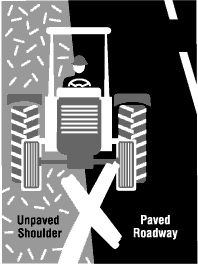
- Occupy the entire traffic lane. Do not straddle one-half of the lane and the shoulder--it confuses other drivers.
- Slow down and pull over to let traffic pass if it is safe to do so. Choose a level location with good visibility in both directions.
- Use the throttle rather than the brakes to slow down if towing one or more pieces of machinery on a highway to avoid jack-knifing equipment.
- Descend a hill in the same gear you would use to ascend when carrying a load.
- Stay off the roads after dark unless necessary and then only when equipment is properly lit (white light(s) in front; red light(s) at rear).
- Always signal your plan to slow, stop, or turn.
- Use hand signals if your tractor does not have signal lights.
- Equip your vehicle with signals if the load or equipment does not allow other drivers to see hand signals.
- Ensure that there is enough room to maneuver safely before entering or crossing a road or turning across a lane.
- Keep signs and lights clean.
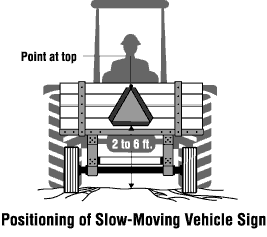
- Replace faded or damaged slow-moving vehicle signs.
- Indicate the size of equipment with flags during the day and with lights at night.
- Check your operator manual as some tractors may freewheel in higher gears. Freewheeling can be dangerous when travelling downhill. Use a lower gear range.
What should you not do?
Back to top- Do not allow riders on the tractor or towed equipment.
- Do not take equipment out of gear to "freewheel" downhill. The resulting speed could cause severe steering and braking problems. Tractors are not designed for downshifting gears while moving.
- Do not drive partly on the shoulder and partly on the paved road.
- Fact sheet last revised: 2025-05-27