Impairment at Work - Reporting and Responding
On this page
- Why should impairment be reported?
- What is an example of a reporting suspected impairment tool?
- What should be done if impairment is suspected?
- What is meant by fit for work?
- How can converstations about impairment and safety be started?
- What if a formal response is required?
- What is an example of how to document a suspected impairment incident?
- What other steps can an organization take?
Why should impairment be reported?
Back to topThis document covers information about reporting and responding to impairment in the workplace. For more information, please also see the OSH Answers document Impairment at Work – Policy and Recognition.
If impairment is suspected, employers should consider if there is a risk to the individual’s safety or the safety of others. For example, while impaired:
- Does the person have the ability to perform the job or task safely (e.g., driving, operating machinery, use of sharp objects)?
- Is there an impact on cognitive ability or judgement?
As with any hazard, and as part of their education and training, workers and supervisors should receive education and training to be able to be aware of the signs and symptoms of impairment. If anyone suspects impairment in others or wishes to report their own inability to work safely, this concern should be reported to the supervisor or delegated person(s). Follow your organization's policy about who will respond to the concern.
What is an example of a reporting suspected impairment tool?
Back to topA sample tool is below. Be sure to customize this tool to suit the needs of your workplace.
Reporting should be based on observation – do not assume that, for example, substance abuse is the cause of impairment. Reporting impairment as a hazard is an alert that there are signs of concern about the individual’s ability to work safely or to not endanger the health and safety of others. Reporting is one step in the investigation process.
Sample Tool - Reporting Suspected Impairment
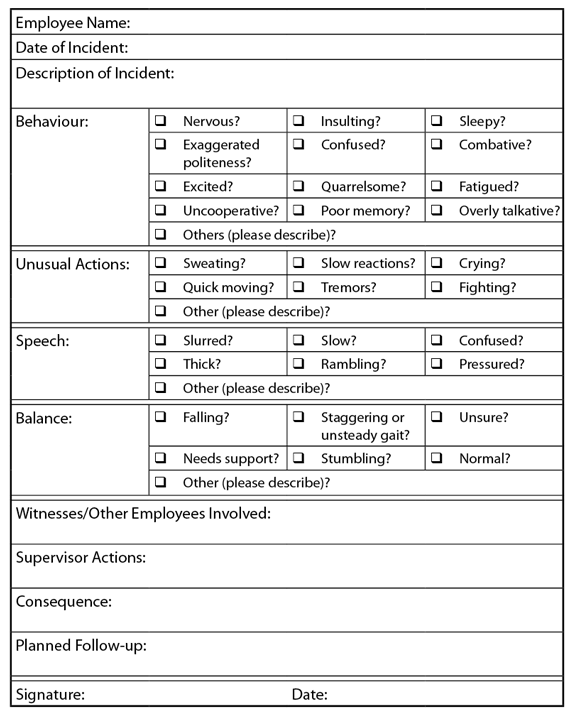
Adapted from: Problematic Substance Use that Impacts the Workplace. Atlantic Canada Council on Addiction (ACCA). (no date)
What should be done if impairment is suspected?
Back to topIf a supervisor or co-worker becomes aware of a worker who is showing signs of impairment (regardless of cause), either through a suspected impairment report or observation, it is very important that action is taken. Examples of steps to take include, but are not limited to:
- Speak to the worker in a private area to discuss your observations and concerns.
- If the person is in crisis and needs immediate assistance, go to the emergency department of the nearest hospital or call 9-1-1.
- Ask another supervisor or designated person to be present as a witness. Workers may request a person to be their representative as well.
- Remove any stigma regarding impairment. Talk about the observed behaviours. State the concern is about safety for others and themselves.
- State your concerns about safety to the worker and ask if they can explain what is going on. Examples of how to start this conversation are listed below.
- Based on the worker's response, discuss options, where applicable and available.
- Follow the established procedures outlined in your organization's program. In some cases, it may be necessary to assign non-safety sensitive work, or to ask the worker to stop their work.
- If applicable and following privacy and confidentiality requirements, notify senior management and the union representative.
- Provide information on your employee assistance program (EAP), if one is available, or other health supports. Encourage access and use of support programs, and reassure the worker that the services are voluntary and confidential.
- If necessary, have the worker escorted home; do not allow them to drive if you suspect impairment.
- Where necessary, follow procedures for accommodation.
- If disciplinary action is required, follow your organization’s policies on progressive discipline
Every discussion should be accompanied by an incident report. The report should include the events preceding the incident, identification of the worker’s unsafe work practices, the matters discussed with the worker, that management and union representatives were notified, a list of all actions taken, and any recommendations made to the worker.
Recall it is not the employer or supervisor’s duty to diagnose a worker, or to know if they have a disability. Employers can observe changes in a worker’s attendance, performance, or behaviour. They can initiate a discussion about the issue(s) as related to work, and discuss possible solutions.
The discussion between the employer and worker may need to occur more than once. Use may fall on a spectrum, and an individual may move along the spectrum at any time. The employer’s role is to maintain a safe workplace for all and support each worker’s success in remaining at work and being functional in their role. Provide a range of supports and practice empathy, not sympathy. Focus on solutions, but if disciplinary action is necessary, it is important to follow through.
What is meant by fit for work?
Back to topAn employer’s concern is centred on the individual’s ability to do their tasks safely. Also known as fit (or fitness) for work, this concept describes the ability to perform assigned duties safely and to an acceptable level. Fit for work usually applies to a time period, such as that task or that day. This measure may be used in many situations, including fatigue, alcohol or other substance use, mental health, or medical fitness.
If a worker is considered unfit for work, options include:
- Assess the situation
- Assess if work duties may be contributing to the observations
- Arrange for a medical assessment if necessary
Note: While fit for work is used for a time period or task, there is also be a process called “fit to work” which often refers to a process involving a medical assessment done when an employer wishes to be sure a worker can safely do a specific job or task. Fit to work assessments are most often done to determine medical fitness after an illness or injury.
How can converstations about impairment and safety be started?
Back to topThe supervisor or a delegated person should have a conversation with any individual who is suspected of being impaired at work. It is best to explore the situation and gather information before coming to conclusions. Discuss the observed behaviours or actions.Concerns should be stated in an unbiased and factual manner. Do not place blame or make assumptions. Express the concerns by using statements such as:
- We would like to talk to you as we have noticed the following actions or behaviours lately. We are concerned for your safety and that you or someone else may get hurt.
- It was reported that you were almost involved in an incident. Can we discuss what happened leading to this event?
- We are concerned about your health and well-being. We are also concerned about your safety and the safety of others. Can we discuss some issues that have come to our attention?
- You don't seem yourself today, and we are concerned. Can we talk?
- Are you okay?
- For your safety and the safety of others, we would like to discuss...
Be clear that the intent is to maintain a safe working environment or that the organization is concerned for their well-being. Try to anticipate the worker's reaction so that you are prepared, but remain open and responsive to what is discussed. Do not make assumptions about the cause of the issue. Identify any consequences if the issue continues and what steps must be taken. Discuss and outline what each party will do and how the situation will be addressed. If necessary, determine a time to meet again when the worker is not showing signs of impairment to discuss further.
Document this discussion.
What if a formal response is required?
Back to topIf a formal response is appropriate, the actions taken should be proportional to what was discovered during the discussion and inquiry. Responses can include discussing:
- expectations about work performance,
- expectations about behaviour at work,
- methods for conflict resolution,
- assignment of alternative tasks,
- removal from the workplace (either temporarily or until deemed able to return),
- requirement for the worker to report to medical or support services, or
- requirement for the worker to report to substance testing (if applicable).
Every response should be accompanied by an incident report. The report should include the events preceding the incident or observed behaviours of concern, identification of the worker’s unsafe work practices, the matters discussed with the worker, that management and union representatives were notified, a list of all actions taken, and any recommendations made to the worker.
What is an example of how to document a suspected impairment incident?
Back to topSteps a workplace can take include:
- Address the uncertainty to report concerns about others or self-disclosure.
- Address views such as stigma, discrimination, or shame.
- Encourage and support health and overall wellness (including stress management, healthy eating, and exercise).
- Encourage early identification, including education on how to recognize signs and symptoms.
- Communicate what supports are available to workers, including resources available from the employer or community, such as intervention and counselling.
- Help the individual find access to support and care (e.g., provide flexible work arrangements, time to attend appointments, possible benefits or financial support, etc.).
- Be flexible – allow the individual to work in the location that provides the greater support (e.g., at home or at the workplace).
What other steps can an organization take?
Back to topEvery discussion should be documented by an incident response report. The report should include the events that happened before the incident, identification of the worker's unsafe work practices, the matters discussed with the worker (while maintaining confidentiality), that management and union representatives were notified if applicable, a list of all actions taken, and any recommendations made to the worker.
A sample tool may be as follows. Be sure to customize this tool to suit your workplace needs.
| Sample Tool – Responding to Suspected Impairment | |
|---|---|
| Worker Name: | Date: |
| Supervisor Name: | |
| Observer Name: | |
| Worker/Union Observer: | |
| Incidient or Concern Details | |
Action Note: If there is concern the worker may be or may become violent or threatening, or may be in need of medical assistance, call security, police, or 911. | |
| Observations | |
| Concerns regarding safety, health, or other work-related issues | |
| Details from discussion with worker | |
| Discussion of available services, if applicable | |
| Safe arrangements (driven by/taxi, other work assigned, etc.) | |
| Next steps / Return to work process | |
| Notifications made to: | |
| Signatures | |
| Worker: | Date: |
| Supervisor: | Date: |
| Observer: | Date: |
| Observer: | Date: |
- Fact sheet last revised: 2026-04-30