Canadian Centre for Occupational Health and Safety’s 2026-27 Departmental Plan
Contents:
Copyright information
© His Majesty the King in Right of Canada, as represented by the Minister of Jobs and Families and Minister Responsible for the Federal Economic Development Agency for Northern Ontario, 2026, ISSN: 2571-705X.
At a glance
This departmental plan details the Canadian Centre for Occupational Health and Safety’s (CCOHS) priorities, plans, and associated costs for the upcoming three fiscal years.
These plans align with the priorities outlined in the Mandate Letter, as well as CCOHS’ Vision, mission, raison d’être and operating context.
Key priorities
CCOHS identified the following key priorities for 2026-27:
- Priority 1: Show national leadership on health and safety issues and be the go-to experts for health and safety guidance.
- Priority 2: Demonstrate service excellence by simplifying and streamlining processes and enhancing client service delivery.
- Priority 3: Achieve responsible growth by growing reach and impact and reinvesting to develop new and innovative products and services.
- Priority 4: Achieve an employee experience that consistently models CCOHS values and health and safety excellence.
Comprehensive Expenditure Review
The government is committed to restraining the growth of day-to-day operational spending to make investments that will grow the economy and benefit Canadians.
As part of meeting this commitment, CCOHS is planning the following spending reductions:
- 2026-27: $474,000
- 2027-28: $632,000
- 2028-29: $948,000
It is anticipated that these spending reductions will involve a decrease of approximately six full-time equivalents by 2028-29.
CCOHS will achieve these reductions by doing the following:
- Improving operational efficiency across the entire organization without eliminating or reducing external-facing services.
- Most reductions in full-time equivalents are expected to be achieved through attrition.
The figures in this departmental plan reflect these reductions.
Highlights for CCOHS in 2026-27
CCOHS is Canada's trusted source for the advancement of workplace health and safety. We serve Canadians, and the world, with credible and relevant tools and resources to improve workplace health and safety programs. We believe that all Canadians have a fundamental right to a healthy and safe working environment. Through our programs, services, knowledge, commitment, and action, CCOHS will continue its efforts to advance health and safety in the workplace.
In 2026-27, total planned spending (including internal services) for CCOHS is $15,508,377 and total planned full-time equivalent staff (including internal services) is 110.7.
Summary of planned results
The following provides a summary of the results the department achieved in 2024-25 under its main areas of activity, called “core responsibilities.”
Core responsibility: National Occupational Health and Safety Resource
CCOHS offers a wide range of products and services that promote workplace health and safety and encourage attitudes and methods that can lead to improved worker physical and mental health. In 2026-27, we will continue to update and enhance our resources to better meet the needs of workers and workplaces across Canada. We will leverage technology to ensure information and products are accessible and offered in a variety of formats.
The Business Safety Portal offers an accessible and low-cost solution for business owners, particularly small and medium-sized enterprises, and other organizational leaders to understand and help meet their occupational health and safety responsibilities to protect workers from injuries and illness. We will enhance the portal with improved functionality and additional curated workplace safety resources relevant for small businesses. We are engaging with provincial and territorial governments and other organizations to customize the portal and make it widely available.
Collaboration with federal, provincial, territorial and other governments, labour and employers allows CCOHS to expand the quality and quantity of resources and programs available to workers and workplaces across Canada. We are working with the Canadian Association of Administrators of Labour Legislation subcommittee on Occupational Safety and Health to remove barriers to labour mobility and contribute to building one Canadian economy while maintaining high health and safety standards and practices. We will continue to enhance occupational health and safety in Canada through partnerships, collaborations and knowledge translation.
Planned spending: $10,297,012
Planned human resources: 73.7
More information about National Occupational Health and Safety Resource can be found in the full plan.
For complete information on CCOHS’ total planned spending and human resources, read the Planned spending and human resources section of the full plan.
From the President

Anne Tennier, P.Eng., EP
President and Chief Executive Officer
It is my pleasure to share the CCOHS 2026-27 Departmental Plan. This year’s plan reflects our ongoing commitment to help make workplaces across Canada safer and healthier for everyone.
This report provides an overview of the goals and intentions we set to achieve as outlined in our 2023-2027 Strategic Plan. Our focus remains on fostering collaborations and building robust partnerships with governments, industry stakeholders, and organizations in Canada to strengthen workplace safety in the following key sectors: small businesses, healthcare, federal agencies, community services, and Indigenous communities. To support them, we will develop tailored resources that meet their needs and challenges, leveraging technology to create innovative tools and platforms that will help enhance safety in the workplace.
We are driven by our mission to address health and safety issues that workers in Canada face in workplaces every day. We will expand our educational resources on mental health, workplace harassment and violence, chemical safety, the effects of climate change, and musculoskeletal disorder prevention. This includes developing new fact sheets, infographics, posters and online courses.
Accessibility and inclusivity are fundamental to our work. We will continue to ensure our resources are available in English and French with a plan to introduce materials with new languages this year. Our guidance is written in plain language to make it easy to understand and can be used with communication-based accessibility aids for those who need them. We want to empower every worker with the tools and knowledge they need to create a safe and healthy workplace.
These initiatives represent an overview of our priorities for the 2026-27 period. Full details of our planned results can be found in the “Plans to deliver on core responsibilities and internal services” section of this report.
Anne Tennier, P.Eng. EP
President and Chief Executive Officer
Plans to deliver on core responsibilities and internal services
Core responsibilities and internal services
Core responsibility: National Occupational Health and Safety Resource
Description
The goal of the Canadian Centre for Occupational Health and Safety is to provide easy access to credible information on occupational health and safety to help workers in Canada be safe at work, and support employers, labour groups and governments in their efforts to create healthy and safe workplaces. The Canadian Centre for Occupational Health and Safety, as a national institute, provides impartial information through various free and for fee bilingual products and services. Workers and employers in Canada can access a free, confidential service to have their health and safety questions answered personally via telephone, e-mail, person-to-person, fax or mail. In addition, a broad range of online and print resources are offered which support safety and health information needs of workers and workplaces in Canada. Products and services may be financially supported through cost recovery efforts, contributions from the Government of Canada and contributions from other stakeholders.
The Canadian Centre for Occupational Health and Safety collects, evaluates, creates and publishes authoritative information resources on occupational health and safety for the benefit of the working population in Canada. This information is used for education and training, research, development of policy and best practices, improvement of health and safety programs, achieving compliance, and for personal use. When the product or service provided by the Canadian Centre for Occupational Health and Safety is offered to stakeholders such as individuals, groups, and organizations within Canada and abroad with benefits beyond those enjoyed by the general public, the product or service becomes part of the cost-recovery program and a fee is charged.
The Canadian Centre for Occupational Health and Safety promotes and facilitates consultation and cooperation among federal, provincial and territorial jurisdictions and participation by labour, employers and other stakeholders in order to assist in the establishment and maintenance of high standards and occupational health and safety initiatives for the Canadian context. The sharing of resources results in the coordinated and mutually beneficial development of unique programs, products and services. Collaborative projects are usually supported with a combination of financial and non-financial contributions to the programs by partners and stakeholders and result in advancement of the health and safety initiatives.
Quality of life impacts
National Occupational Health and Safety Resource contributes to several domains and indicators from the Quality of Life Framework for Canada by promoting products and services to improve occupational health and safety. The domains are health (perceived health and perceived mental health indicators) and prosperity (job satisfaction indicator). When workers are safe and healthy at work, their overall health and mental health, as well as job satisfaction, are improved.
Indicators, results and targets
This section presents details on the department’s indicators, the actual results from the three most recently reported fiscal years, the targets and target dates for National Occupational Health and Safety Resource. Details are presented by departmental result.
Table 1: Occupational health and safety resources are utilized for the benefit of workers in Canada.
Table 1 provides a summary of the target and actual results for each indicator associated with the results under Occupational health and safety resources are utilized for the benefit of workers in Canada.
|
Departmental Result Indicators
|
Actual Results
|
2026–27 Target
|
Date to achieve target
|
|---|---|---|---|
|
Percentage of survey respondents who indicate information will be used to improve health and safety in their workplace.
|
No results available.1
|
At least 85%
|
March 2027
|
1Actual results for previous years are not available as this is a new indicator.
Table 2: Collaboration with federal, provincial, territorial and other governments, labour and employers is leveraged to improve occupational health and safety standards and practices.
Table 2 provides a summary of the target and actual results for each indicator associated with the results under Collaboration with federal, provincial, territorial and other governments, labour and employers is leveraged to improve occupational health and safety standards and practices.
|
Departmental Result Indicators
|
Actual Results
|
2026–27 Target
|
Date to achieve target
|
|---|---|---|---|
|
Number of new collaborative initiatives.
|
2022–23: 9
2023–24: 5 2024–25: 3 |
At least 4
|
March 2027
|
|
Collaborator satisfaction with initiative outcomes.
|
No results available.2
|
At least 85%
|
March 2027
|
2Actual results for previous years are not available as this is a new indicator.
Additional information on the detailed results and performance information for CCOHS’ program inventory is available on GC InfoBase.
Plans to achieve results
The following section describes the planned results for National Occupational Health and Safety Resource in 2026-27.
Occupational health and safety resources are utilized for the benefit of workers in Canada.
Promote workplace health and safety and encourage attitudes and methods that can lead to improved worker physical and mental health, through a wide range of products and services.
Results we plan to achieve
- Update and enhance occupational health and safety resources to better meet the needs of workers and workplaces across Canada. We will expand the collection of OSH Answers fact sheets, a free information hub for workers and employers seeking information on occupational health and safety topics and emerging issues. Additionally, our collection of infographics, posters and fast fact tips cards will be enhanced with new topics. These resources are offered as free online downloads and for a fee in print.
- Leverage technology to provide resources that can be easily implemented in the workplace, explore translation tools to provide resources in languages other than French or English, and continue to ensure information and products are accessible and offered in a variety of formats.
- Enhance the Business Safety Portal with improved functionality and additional curated workplace safety resources relevant for small businesses. We will continue to build on this innovative tool to increase usage amongst workers and workplaces in this sector. We are engaging with provincial and territorial governments and relevant organizations to customize the portal and make it widely available across jurisdictions through bulk subscriptions, supported by jurisdictional partners.
Collaboration with federal, provincial, territorial and other governments, labour and employers is leveraged to improve occupational health and safety standards and practices.
Collaborative initiatives expand the quality and quantity of resources and programs available to workers and workplaces across the country.
Results we plan to achieve
- Continue to collaborate with the Canadian Association of Administrators of Labour Legislation subcommittee on Occupational Safety and Health to work towards harmonization or recognition of occupational health and safety standards across the country. This will remove barriers to labour mobility and contribute to building one Canadian economy while maintaining high health and safety standards and practices.
- Enhance occupational health and safety in Canada through partnerships, collaborations and knowledge translation. In working with provincial, territorial and other governments and relevant organizations, we will mobilize scientific and technical knowledge, translated into plain language, for more effective prevention of work-related accidents and occupational diseases. These partnerships provide opportunities to share credible information on emerging occupational health and safety issues with workers and workplaces in Canada.
- Create new and foster existing relationships with international occupational health and safety organizations to stay current on international good practices applicable to workers and workplaces in Canada. Information and good practices learned will be shared and promoted to workplaces in Canada to help strengthen their own health and safety programs.
Gender-based Analysis Plus
As a small department, CCOHS does not have resources to dedicate full-time employees to Gender-based analysis plus (GBA Plus). However, CCOHS recognizes its importance and is committed to ensuring diverse groups of workers in Canada benefit from our programs. The CCOHS leadership team ensures that GBA Plus perspectives are integrated in decision-making.
Demographic information is collected through website and product user surveys. This information is used to assess the potential impact of our products and services and tailor information to better serve diverse populations in Canada.
Planned resources to achieve results
Table 3: Planned resources to achieve results for National Occupational Health and Safety Resource
Table 3 provides a summary of the planned spending and full-time equivalents required to achieve results.
|
Resource
|
Planned
|
|---|---|
|
Spending
|
$10,323,347
|
|
Full-time equivalents
|
73.7
|
Complete financial and human resources information for CCOHS’ program inventory is available on GC InfoBase.
Program inventory
National Occupational Health and Safety Resource is supported by the following programs:
- Occupational health and safety information and services
Additional information related to the program inventory for National Occupational Health and Safety Resource is available on the Results page on GC InfoBase.
Summary of changes to reporting framework since last year
- CCOHS offers a wide range of products and services that promote workplace health and safety. The departmental result “Occupational Health and Safety resources are utilized for the benefit of workers in Canada” has been added this year to assess the impact across all our products and services.
- Collaboration remains an important part of the framework. The departmental result “Collaboration with federal, provincial, territorial and other governments, labour and employers is leveraged to improve occupational health and safety standards and practices” has been updated. In addition to the existing count of collaborative initiatives, an indicator has been added to assess collaborator satisfaction with these initiatives, which ensures that these initiatives deliver the intended benefits to workers and workplaces in Canada.
- Two departmental results have been removed. Some of this information is reported as part of the program outcomes and results.
Internal services
Description
Internal services are the services that are provided within a department so that it can meet its corporate obligations and deliver its programs. There are 10 categories of internal services:
- acquisition management services
- communications services
- financial management services
- human resources management services
- information management services
- information technology services
- legal services
- material management services
- management and oversight services
- real property management services
Plans to achieve results
This section presents the department’s plans to achieve results and meet targets for internal services.
Internal services at CCOHS will continue working to achieve the priorities in the strategic plan and support the core responsibility: National Occupational Health and Safety Resource.
- CCOHS continues to deliver its products and services in support of the strategic plan and in alignment with the government direction on delivering digital services to workers and workplaces in Canada. We will refresh and reinvest in digital and information technology infrastructure to meet the ongoing needs of its stakeholders. These back-end infrastructure updates will enhance client experience and satisfaction, as well as support increased reach to support more workers and workplaces in Canada. We will support continuous improvement and enhancements to protect against cyber security risks.
- Priority 4 of the strategic plan is to achieve an employee experience that consistently models CCOHS values and health and safety excellence. To achieve this, we will continue to improve the overall working experience of employees through the continued focus on CCOHS' corporate values. We will continue to align policies and procedures to support CCOHS’ corporate values and promote diversity and inclusion strategies in the workplace.
- Internal services will support CCOHS’ priority to further CCOHS’ national leadership on occupational health and safety issues being the go-to experts for health and safety guidance. Human resources and other internal services will be aligned to support this work, ensuring that CCOHS has the professional talent to deliver relevant products and services to support workers and workplaces in Canada.
Planned resources to achieve results
Table 4: Planned resources to achieve results for internal services this year
Table 4 provides a summary of the planned spending and full-time equivalents required to achieve results.
|
Resource
|
Planned
|
|---|---|
|
Spending
|
$5,185,030
|
|
Full-time equivalents
|
37.0
|
Complete financial and human resources information for CCOHS’ program inventory is available on GC InfoBase.
Planning for contracts awarded to Indigenous businesses
Government of Canada departments are to meet a target of awarding at least 5% of the total value of contracts to Indigenous businesses each year.
CCOHS evaluated internal procurement processes and identified potential opportunities to award contracts to Indigenous vendors. CCOHS will continue to work to achieve the target by focusing on review of annual budget allocation and required procurement methodologies.
CCOHS is a small department with limited resources and contracting opportunities. CCOHS regularly uses prescribed supply arrangements designated by Shared Services Canada (SSC) which limits the ability to seek out Indigenous vendors. Internal processes are being drafted to support ongoing review of needs and subsequent procurement options available to identify Indigenous vendors for consideration.
The majority of awarded contracts are designated as software or hardware. CCOHS collaborates with SSC to process software and hardware orders through their client portals (ITPro and P2P). This procurement methodology allows CCOHS to identify Indigenous designated re-sellers for hardware requirements that will be used to attain quotations as needed. In addition, CCOHS will utilize SSC contacts to support the identification of Indigenous re-sellers for software needs.
CCOHS utilizes the Indigenous vendor selection tools available within the Centralized Professional Services System to support professional services contracting. This tool facilitates the identification of pre-qualified vendors and enables the inclusion of approved Indigenous vendors in the contracting process.
Table 5: Percentage of contracts planned and awarded to Indigenous businesses
Table 5 presents the current, actual results with forecasted and planned results for the total percentage of contracts the department awarded to Indigenous businesses.
|
5% Reporting Field
|
2024-25 Results
|
2025-26 Forecasted Result
|
2026-27 Planned Result
|
|---|---|---|---|
|
Total percentage of contracts with Indigenous businesses
|
7.1%
|
5%
|
5%
|
Department-wide considerations
Related government priorities
United Nations 2030 Agenda for Sustainable Development and the UN Sustainable Development Goals
More information on CCOHS’ contributions to Canada’s Federal Implementation Plan on the 2030 Agenda and the Federal Sustainable Development Strategy can be found in our Departmental Sustainable Development Strategy.
Artificial Intelligence
CCOHS will explore opportunities to implement artificial intelligence in our workflows to increase productivity and improve service delivery for existing products and services. We will continually review any policies and procedures associated with this technology to ensure that it is implemented in a safe and effective way that helps achieve our departmental priorities.
Key risks
The CCOHS funding model presents a risk as a significant portion of its operating budget must be generated through cost recovery. Therefore, CCOHS’ products and services must be continually updated to be marketable.
To continue to provide relevant leadership training and support to workers in Canada on emerging occupational health and safety issues, CCOHS relies heavily on maintaining a high level of professional development of its staff. Lack of properly directed investment in talent management will have a significant impact on the ability of CCOHS to perform optimally in the research and timely delivery of relevant products and services on topics which may quickly become areas of concern for workers both in Canada and globally.
CCOHS delivers most of its products and services to workers in Canada through electronic delivery and must stay up to date on new technology as traditional delivery methods for its content are unsustainable and out-dated, resulting in a risk of client and revenue attrition.
CCOHS must also ensure that it is adequately protected against increasing threat from unauthorized exploitation of systems, networks and technologies. Such threats can have significant impact to CCOHS’ operations and ability to safely conduct business transactions. CCOHS maintains sufficient levels of investment in technology required to support continuous improvements in its on-line resource delivery channels and to protect against cyber security risks.
Planned spending and human resources
This section provides an overview of CCOHS’ planned spending and human resources for the next three fiscal years and of planned spending for 2026-27 with actual spending from previous years.
Spending
This section presents an overview of the department's planned expenditures from 2023-24 to 2028-29.
Budgetary performance summary
Table 6: Three-year spending summary for core responsibilities and internal services (dollars)
Table 6 presents CCOHS’ spending over the past three years to carry out its core responsibilities and for internal services. Amounts for the 2025-26 fiscal year are forecasted based on spending to date.
|
Core responsibilities and internal services
|
2023-24 Actual Expenditures
|
2024-25 Actual Expenditures
|
2025-26 Forecast Spending
|
|---|---|---|---|
|
National Occupational Health and Safety Resource
|
10,256,443
|
9,982,246
|
9,079,889
|
|
Internal services
|
4,756,067
|
4,896,926
|
4,827,681
|
|
Total (s)
|
15,012,510
|
14,879,172
|
13,907,570
|
Analysis of the past three years of spending
The total authorities available for use shown in the table above represents the planned Parliamentary appropriations and revenue sources including the main estimates, supplementary estimates, recoveries and the use of cash respendable revenues pursuant to section 6(1)(g) of the Canadian Centre for Occupational Health and Safety Act (CCOHS Act).
Spending forecasted in 2025-26 are based on main estimates which do not include the adjustment that will be made at the end of the year to account for additional costs that will be funded by CCOHS’ respendable/reinvestment authorities per section 6(1)(g) of the CCOHS Act.
More financial information from previous years is available on the Finances section of GC Infobase.
Table 7: Planned three-year spending on core responsibilities and internal services (dollars)
Table 7 presents CCOHS’ planned spending over the next three years by core responsibilities and for internal services.
|
Core responsibilities and Internal services
|
2026-27 Planned Spending
|
2027-28 Planned Spending
|
2028-29 Planned Spending
|
|---|---|---|---|
|
National Occupational Health and Safety Resource
|
10,323,347
|
10,203,638
|
9,869,562
|
|
Internal services
|
5,185,030
|
5,159,926
|
5,204,377
|
|
Total
|
15,508,377
|
15,363,564
|
15,073,939
|
Analysis of the next three years of spending
Planned spending for fiscal years 2026-27 to 2028-29 represents authorities approved in the 2026-27 budgetary estimates and do not represent the use of CCOHS’ respendable/reinvestment authorities, as these authorities are only reported upon planned use.
More detailed financial information on planned is available on the Finances section of GC Infobase.
Funding
This section provides an overview of the department's voted and statutory funding for its core responsibilities and for internal services. For further information on funding authorities, consult the Government of Canada budgets and expenditures.
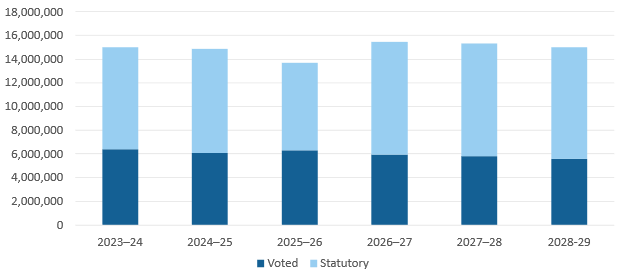
Graph 1 summarizes the department's approved voted and statutory funding from 2023-24 to 2028-29.
Text description of graph 1
|
Fiscal year
|
Total
|
Voted
|
Statutory
|
|---|---|---|---|
|
2023-24
|
15,012,510
|
6,389,195
|
8,623,315
|
|
2024-25
|
14,879,172
|
6,078,790
|
8,800,382
|
|
2025-26
|
13,907,570
|
6,547,185
|
7,360,385
|
|
2026-27
|
15,508,377
|
5,947,344
|
9,561,033
|
|
2027-28
|
15,363,564
|
5,822,934
|
9,540,630
|
|
2028-29
|
15,073,939
|
5,574,115
|
9,499,824
|
Analysis of statutory and voted funding over a six-year period
The total planned spending reported in fiscal years 2023-24 to 2025-26 includes Parliamentary appropriations and revenue sources including main estimates, recoveries and the use of cash respendable revenues pursuant to section 6(1)(g) of the CCOHS Act.
Fiscal 2026-27 to 2028-29 includes planned spending authorities which represent authorities approved in the 2026-27 main estimates and do not represent the use of CCOHS’ respendable revenues, as respendable revenues are only reported upon the approved disbursement of the funds within the fiscal year.
For further information on CCOHS’ departmental appropriations, consult the 2026-27 Main Estimates.
Future-oriented condensed statement of operations
The future-oriented condensed statement of operations provides an overview of CCOHS’ operations for 2025-26 to 2026-27.
Table 8: Future-oriented condensed statement of operations for the year ended March 31, 2027 (dollars)
Table 8 summarizes the expenses and revenues which net to the cost of operations before government funding and transfers for 2025-26 to 2026-27. The forecast and planned amounts in this statement of operations were prepared on an accrual basis. The forecast and planned amounts presented in other sections of the Departmental Plan were prepared on an expenditure basis. Amounts may therefore differ.
|
Financial information
|
2025-26 Forecast results
|
2026-27 Planned results
|
Difference (Planned results minus forecasted)
|
|---|---|---|---|
|
Total expenses
|
18,398,584
|
18,929,493
|
530,909
|
|
Total revenues
|
8,889,625
|
8,824,892
|
(64,733)
|
|
Net cost of operations before government funding and transfers
|
9,508,959
|
10,104,601
|
595,642
|
A more detailed Future-Oriented Statement of Operations and associated Notes for 2026-27 including a reconciliation of the net cost of operations with the requested authorities, is available on CCOHS’ website.
Human resources
This section presents an overview of the department’s actual and planned human resources from 2023-24 to 2028-29.
Table 9: Actual human resources for core responsibilities and internal services
Table 9 shows a summary of human resources, in full-time equivalents, for CCOHS’ core responsibilities and for its internal services for the previous three fiscal years. Human resources for the 2025-26 fiscal year are forecasted based on year to date.
|
Core responsibilities and internal services
|
2023-24 Actual full-time equivalents
|
2024-25 Actual full-time equivalents
|
2025-26 Forecasted full-time equivalents
|
|---|---|---|---|
|
National Occupational Health and Safety Resource
|
68.0
|
68.9
|
70.4
|
|
Internal services
|
30.8
|
34.8
|
37.4
|
|
Total
|
98.8
|
103.7
|
107.8
|
Analysis of human resources for the last three years
The increase in forecasted full-time equivalents is primarily due to the investment to support back-end infrastructure updates to our information technology infrastructure.
Table 10: Human resources planning summary for core responsibilities and internal services
Table 10 shows information on human resources, in full-time equivalents, for each of CCOHS’ core responsibilities and for its internal services planned for the next three years.
|
Core responsibilities and internal services
|
2026-27 Planned full-time equivalents
|
2027-28 Planned full-time equivalents
|
2028-29 Planned full-time equivalents
|
|---|---|---|---|
|
National Occupational Health and Safety Resource
|
73.7
|
73.2
|
70.2
|
|
Internal services
|
37.0
|
37.0
|
37.0
|
|
Total
|
110.7
|
110.2
|
107.2
|
Analysis of human resources for the next three years
The decrease in planned full-time equivalents is primarily attributable to efficiencies identified through the Comprehensive Expenditure Review. Most reductions are expected to occur through attrition.
Federal tax expenditures
CCOHS’ Departmental Plan does not include information on tax expenditures.
The tax system can be used to achieve public policy objectives through the application of special measures such as low tax rates, exemptions, deductions, deferrals and credits. The Department of Finance Canada publishes cost estimates and projections for these measures each year in the Report on Federal Tax Expenditures.
This report also provides detailed background information on tax expenditures, including descriptions, objectives, historical information and references to related federal spending programs as well as evaluations and GBA Plus of tax expenditures.
Corporate information
Departmental profile
Appropriate minister(s): The Honourable Patty Hajdu, Minister of Jobs and Families and Minister Responsible for the Federal Economic Development Agency for Northern Ontario
Institutional head: Anne Tennier, P.Eng. EP, President and Chief Executive Officer
Ministerial portfolio: Labour Program
Enabling instrument(s): Canadian Centre for Occupational Health and Safety Act
Year of incorporation / commencement: 1978
Departmental contact information
Mailing address: 135 Hunter Street East
Hamilton ON L8N 1M5
Telephone: 905-572-2981; 1-800-668-4284 (Canada and US)
Fax: 905-572-2206
Email: resultsreporting@ccohs.ca
Website(s): www.ccohs.ca
Definitions
List of terms
- appropriation (crédit)
- Any authority of Parliament to pay money out of the Consolidated Revenue Fund.
- budgetary expenditures (dépenses budgétaires)
- Operating and capital expenditures; transfer payments to other levels of government, departments or individuals; and payments to Crown corporations.
- core responsibility (responsabilité essentielle)
- An enduring function or role performed by a department. The intentions of the department with respect to a core responsibility are reflected in one or more related departmental results that the department seeks to contribute to or influence.
- Departmental Plan (plan ministériel)
- A report on the plans and expected performance of an appropriated department over a 3year period. Departmental Plans are usually tabled in Parliament each spring.
- departmental result (résultat ministériel)
- A consequence or outcome that a department seeks to achieve. A departmental result is often outside departments’ immediate control, but it should be influenced by program-level outcomes.
- departmental result indicator (indicateur de résultat ministériel)
- A quantitative measure of progress on a departmental result.
- departmental results framework (cadre ministériel des résultats)
- A framework that connects the department’s core responsibilities to its departmental results and departmental result indicators.
- Departmental Results Report (rapport sur les résultats ministériels)
- A report on a department’s actual accomplishments against the plans, priorities and expected results set out in the corresponding Departmental Plan.
- full-time equivalent (équivalent temps plein)
- A measure of the extent to which an employee represents a full person-year charge against a departmental budget. For a particular position, the full-time equivalent figure is the ratio of number of hours the person actually works divided by the standard number of hours set out in the person’s collective agreement.
- gender-based analysis plus (GBA Plus) (analyse comparative entre les sexes plus [ACS Plus])
- Is an analytical tool used to support the development of responsive and inclusive policies, programs, and other initiatives. GBA Plus is a process for understanding who is impacted by the issue or opportunity being addressed by the initiative; identifying how the initiative could be tailored to meet diverse needs of the people most impacted; and anticipating and mitigating any barriers to accessing or benefitting from the initiative. GBA Plus is an intersectional analysis that goes beyond biological (sex) and socio-cultural (gender) differences to consider other factors, such as age, disability, education, ethnicity, economic status, geography (including rurality), language, race, religion, and sexual orientation.
- Using GBA Plus involves taking a gender- and diversity-sensitive approach to our work. Considering all intersecting identity factors as part of GBA Plus, not only sex and gender, is a Government of Canada commitment.
- government priorities (priorités pangouvernementales)
- For the purpose of the 2026-27 Departmental Plan, government priorities are the high-level themes outlining the government’s agenda in the 2025 Speech from the Throne.
- horizontal initiative (initiative horizontale)
- An initiative where two or more federal departments are given funding to pursue a shared outcome, often linked to a government priority.
- Indigenous business (entreprise autochtones)
- Requirements for verifying Indigenous businesses for the purposes of the departmental result report are available through the Indigenous Services Canada Mandatory minimum 5% Indigenous procurement target website.
- non-budgetary expenditures (dépenses non budgétaires)
- Non-budgetary authorities that comprise assets and liabilities transactions for loans, investments and advances, or specified purpose accounts, that have been established under specific statutes or under non-statutory authorities in the Estimates and elsewhere. Non-budgetary transactions are those expenditures and receipts related to the government's financial claims on, and obligations to, outside parties. These consist of transactions in loans, investments and advances; in cash and accounts receivable; in public money received or collected for specified purposes; and in all other assets and liabilities. Other assets and liabilities, not specifically defined in G to P authority codes are to be recorded to an R authority code, which is the residual authority code for all other assets and liabilities.
- performance (rendement)
- What a department did with its resources to achieve its results, how well those results compare to what the department intended to achieve, and how well lessons learned have been identified.
- performance indicator (indicateur de rendement)
- A qualitative or quantitative means of measuring an output or outcome, with the intention of gauging the performance of a department, program, policy or initiative respecting expected results.
- plan (plan)
- The articulation of strategic choices, which provides information on how a department intends to achieve its priorities and associated results. Generally, a plan will explain the logic behind the strategies chosen and tend to focus on actions that lead to the expected result.
- planned spending (dépenses prévues)
- For Departmental Plans and Departmental Results Reports, planned spending refers to those amounts presented in Main Estimates.
- A department is expected to be aware of the authorities that it has sought and received. The determination of planned spending is a departmental responsibility, and departments must be able to defend the expenditure and accrual numbers presented in their Departmental Plans and Departmental Results Reports.
- program (programme)
- Individual or groups of services, activities or combinations thereof that are managed together within the department and focus on a specific set of outputs, outcomes or service levels.
- program inventory (répertoire des programmes)
- Identifies all the department’s programs and describes how resources are organized to contribute to the department’s core responsibilities and results.
- result (résultat)
- A consequence attributed, in part, to a department, policy, program or initiative. Results are not within the control of a single department, policy, program or initiative; instead they are within the area of the department’s influence.
- statutory expenditures (dépenses législatives)
- Expenditures that Parliament has approved through legislation other than appropriation acts. The legislation sets out the purpose of the expenditures and the terms and conditions under which they may be made.
- target (cible)
- A measurable performance or success level that a department, program or initiative plans to achieve within a specified time period. Targets can be either quantitative or qualitative.
- voted expenditures (dépenses votées)
- Expenditures that Parliament approves annually through an appropriation act. The vote wording becomes the governing conditions under which these expenditures may be made.