Scheduled maintenance - Thursday, July 12 at 5:00 PM EDT
We expect this update to take about an hour. Access to this website will be unavailable during this time.

Train new workers on their health and safety rights and responsibilities.
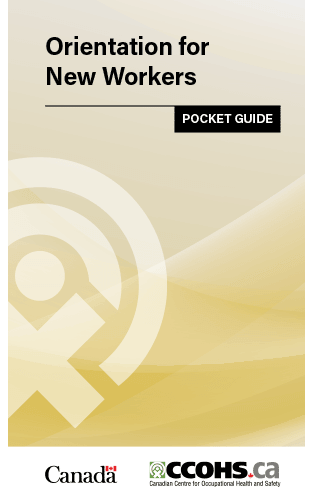
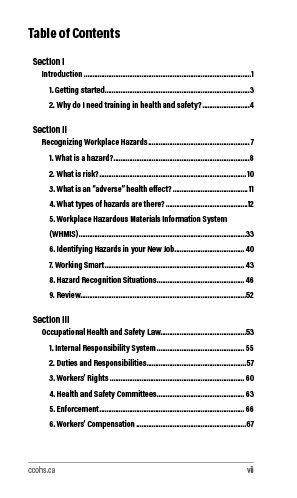
Designed for new, transferred, and returning workers, this guide provides an overview of health and safety rights and responsibilities, hazard recognition, hazard control, emergency preparedness, occupational health and safety programs, and who to contact for additional help.
This 184-page guide is filled with clear-language text including safety tips, charts, diagrams, checklists and illustrations.
This guide can be used as a reference tool for new workers and can also be used by employers as part of their workplace-specific orientation training program.
It provides workers and employers with an overview of:
Workers will learn about potential hazards they may encounter in the workplace and how they can help protect themselves and their co-workers. While this guide is intended for all workers, not all examples and practice scenarios discussed will apply to all workers or workplaces. During job-specific training, employers should highlight which parts of the guide apply.
This guide is recommended for all new workers, including:
Each publication produced by CCOHS undergoes several stages of review. As part of this review, representatives from government, employers, and labour are requested to comment on draft copies of CCOHS documents for technical accuracy and readability.
Although every effort is made to ensure the accuracy and completeness of the information, it is understood that CCOHS makes no warranty as to the accuracy or completeness of such information and assumes no liability for any damages or loss suffered as a result of any inaccuracy or incompleteness therein.
Version: Fourth edition
Publication date: February 2026
CCOHS publications are unique in that they are developed by subject specialists in the field, and reviewed by representatives from labour, employers and government to ensure the content and approach are unbiased and credible.
Although our publications are protected by copyright, permission for non-commercial reproduction may be provided.
Please use our Copyright Authorization Form to request permission, or contact us for more information.