Lifting - General
On this page
What is lifting?
Back to topLifting is a type of manual material handling that involves moving a load to a different position. It can include holding the load in a static position during transportation and placing the load at the destination.
A lifting operation typically involves raising, moving, and lowering a load.
Lifting can be done entirely manually or with the use of equipment. This fact sheet does not cover lifting exclusively with equipment, such as an overhead crane operation.
What kind of injuries can result from lifting?
Back to topLifting can result in:
- Lower back pain
- Herniated disc
- Sciatica
- Muscle strain or tear
- Joint injury (knee, elbow, wrist)
- Joint dislocation
- Fatigue, which can be a risk factor for other injuries
- Acute injuries from falls or dropping the load (such as crushing, fractures, and broken bones)
Please see the OSH Answers fact sheet MMH - Health Hazards for more information.
What are the risk factors that contribute to lifting injuries?
Back to topRisk factors associated with lifting include:
- Improper lifting technique (such as excessive bending of the back and twisting)
- Low muscular and grip strength in comparison to the load that needs to be moved (can be affected by other factors such as age and sex)
- Repetition
- Fatigue
- Existing injuries
Factors about the load itself that can increase the risk of injury during a lift include:
- Distance the load has to travel
- Distance of the load from the body
- Weight of the load
- Grip points on the load
- Size and shape of the load
- Stability of the load (for example, objects inside a box that can shift)
Factors that increase the risk of sudden injury include:
- Condition of the walking surface (slippery, uneven)
- Cluttered workspace
- Obstructed view
- Environmental conditions (such as the temperature being too hot or too cold)
- Distraction
What control measures help make lifting safer?
Back to topWhen lifting is manual and cannot be eliminated or completed by equipment (such as forklifts or cranes), consider the following measures to help reduce the risk of musculoskeletal disorders:
- Reduce the weight of the load or make the load smaller (consider how this can impact the repetition and implement additional controls, as necessary)
- Use suitable lifting equipment whenever possible (Please see MMH - Mechanical Aids for Transporting Materials - I and MMH - Mechanical Aids for Transporting Materials - II to learn more)
- Adjust the position of the load so that it is neither too low nor too high. A lift table, for example, can elevate a load off the ground, making it easier to lift
- Ensure that the load is acceptable for the worker (refer to tools such as the NIOSH Lifting Equation (revised) or the Liberty Mutual (Snook) Tables)
- Ensure that the load has adequate grip points (Please see MMH - Handholds on Load and Gripping Aids - I and MMH - Handholds on Load and Gripping Aids - II to learn more)
- Share the load by getting help from other workers
- Take breaks to reduce repetition
- Practice job rotation so that body parts get rest
- Ensure that workers are provided with information, instruction, and supervision. Information and instruction can include:
- Safe pushing and pulling
- How to recognize musculoskeletal disorders (MSDs) and hazards that cause MSDs
- How to report MSDs and hazards that can cause MSDs
- How to safely use lifting equipment
In addition to the above control measures, consider the following to help prevent sudden injuries associated with lifting operations:
- Ensure that the work surface is non-slip and cordon off any area that could pose a risk of slipping (such as a liquid spill)
- Ensure that the work surface is even or clearly mark uneven floor areas
- Keep walkways clear. Move objects that obstruct the walking path
- Provide comfortable environmental conditions for the work being done (comply with the temperature conditions in the legislation)
- Reduce distractions such as unnecessary communications or noise. Focus on the lift and moving safely
- Provide appropriate personal protective equipment, such as safety footwear that protects the feet in the event the load is dropped, and gloves that provide protection against abrasion and sharp edges (while still allowing a strong grip)
How to lift safely?
Back to top- Prepare for the lift:
- Ensure that the load is an appropriate weight and size
- Warm up the muscles
- Position yourself in the direction you intend to travel, if possible
- Get close to the load. Bend the knees as necessary to avoid excessively bending the back
- Keep the body pointed to the load (avoid twisting the body)
- Keep the spine straight (do not over-arch or over-round the spine)
- Get a good grip with both hands
- Tighten abdominal muscles
- Lift in a smooth, controlled motion (as opposed to a sudden, jerking motion)
- Keep the load close to and as centred on the body as possible
- Keep shoulders low (avoid shrugging)
- Keep elbows tucked in
- Avoid bending to the side
- Avoid bending forward
- Avoid twisting the spine
- When setting down the load:
- Bend the knees
- Keep the load close to the body
- Gently lower the load
- Minimize bending of the back
- Set down the load, taking care to avoid trapping the fingers
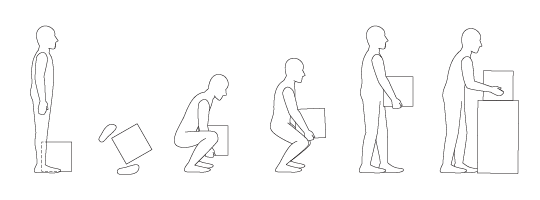
Please see the following OHS Answers fact sheets to learn more about lifting safely:
What is the optimal lifting zone?
Back to topThe optimal lifting zone can be thought of as being above the knees or mid-thigh, and below the shoulders or mid-chest.
Loads should neither be too high nor too low. The risk of injury generally increases when a worker has to lift a load over shoulder height or lower a load that starts from a height higher than the shoulders. Raising the workers’ elevation so that the load does not have to be lifted overhead can help lower the risk.
Similarly, the risk of injury increases when a worker has to lift or lower a load below the knees. Lift tables can help bring loads closer to the worker’s knuckle height, which generally makes lifting and lowering safer.
A load that has to be gripped close to the ground would also likely have a larger vertical displacement than one that is raised off the ground. A larger vertical displacement (that is, a longer travel distance when lifting vertically) results in a smaller distance multiplier (refer to the NIOSH Lifting Equation (revised)) and a lower recommended lifting weight.
In some cases, it may not be possible to adjust the height of the load or the worker. Other control measures may need to be implemented, such as reducing the frequency of the lifts or the weight of the load.
- Fact sheet first published: 2026-02-11
- Fact sheet last revised: 2026-02-11